
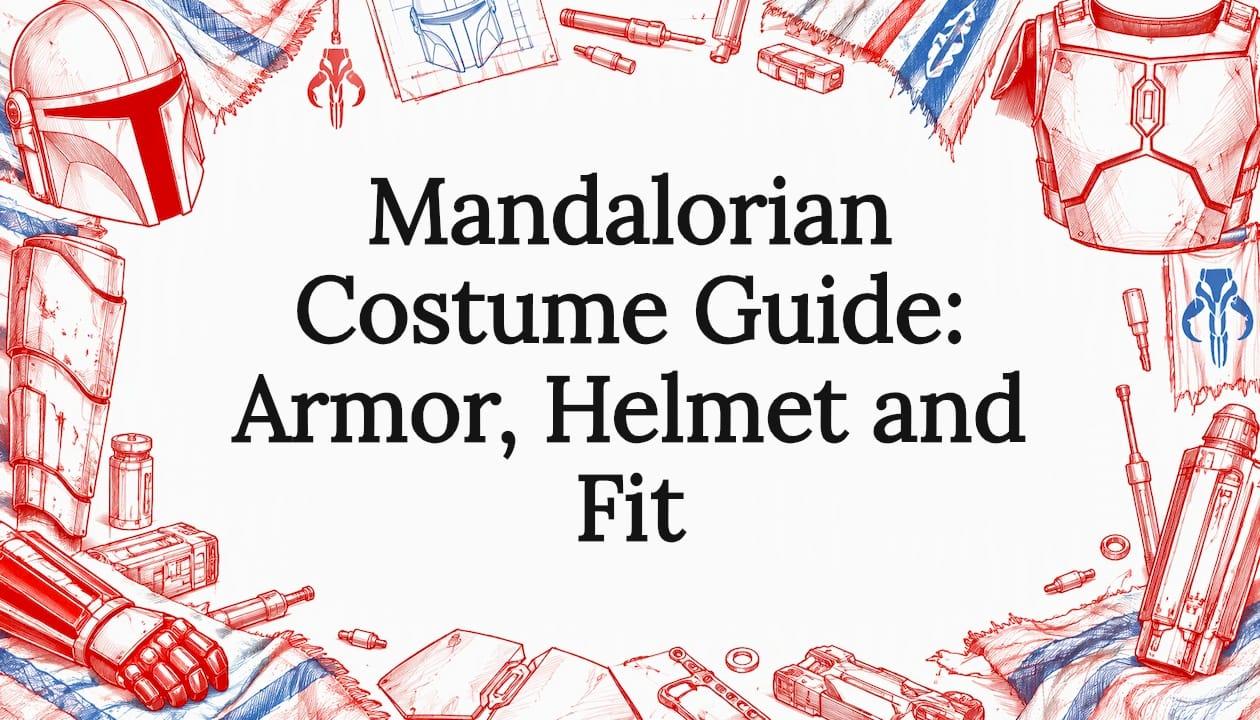
A Mandalorian costume reads as the real thing when it has a T-visor helmet, a hexagon on the chest, layered armor over a soft flight-suit base, and a color scheme that fits one clan. Everything else is detail. You can build the armor yourself, buy ready-made pieces, or mix both. This guide covers the parts, the order to work in, materials, fit, safety and ideas for kids, adults and families.
TL;DR
- Recognition comes from the T-visor helmet, the small hexagon on the chest plate and a consistent color scheme.
- Start with the soft parts (flight suit, vest, boots, gloves, belt), then shape the armor over them.
- For a child, "close enough" is a fine goal. Visibility, breathing room and walking space matter more than screen accuracy.
- If you heat, cut, sand or paint foam, ventilate the space and protect your lungs, eyes and hands.
- Ready-made pieces are a legitimate shortcut. You can mix them with a few handmade details.
Table of Contents
- What makes a costume read as Mandalorian
- Build, buy or mix: choosing your route
- Start with the soft parts
- Fit rules that make armor look right
- Materials and tools for a handmade build
- Work safely when you make the pieces
- Wearing it: comfort and safety on the night
- Mandalorian costume ideas for kids, families and groups
- Our perspective
- Shop ready-made costumes for your next event
- FAQ
- Sources
What makes a costume read as Mandalorian
Mandalorian armor is a set of separate plates, not one shell. According to StarWars.com, the traditional kit includes a helmet, shoulder pauldrons, vambraces, breastplate, codpiece, kneepads, and thigh and shin guards. The same feature says Mandalorians could be spotted by a few simple details, namely the small hexagonal design on the chest plate and the T-visor helmet.
That gives you a priority list. If you only get two things right, make them the helmet and the chest. A viewer across a room, or a neighbor at the front door, will identify the character from the visor shape long before they notice the knee plates.
The helmet
The T-shaped visor is the signature. Fans and builders treat the helmet as the main element of the armor, and the character's creed has them keeping it on in front of others, so a costume without it loses most of its identity. Think about how the helmet works for the person wearing it before you think about how it looks:
- Can the wearer see to the sides and down, not just straight ahead?
- Is there airflow, or will it fog up in a warm room?
- Can the wearer hear someone speaking from a few feet away?
- Does it stay put when the head turns?
For a kid, these questions decide whether the costume survives the first hour. For an adult at a convention, they decide whether you wear it all day or carry it under one arm by lunch.
The armor pieces
One builder's guide, The Mando Way, sorts kits into three classes. Light armor covers the helmet, chest armor, shoulder armor, codpiece, vest, flight suit, boots and gloves, belts and holsters, knee armor, gauntlets and back armor or cape. Medium adds thigh, shin and boot plates. Heavy adds neck armor, full shoulder armor and bicep armor.

That structure is useful because it lets you decide how far to go. A light kit is a complete, recognizable costume. Medium and heavy are upgrades you can add over time.
Color and clan
Color is the quickest way to give your costume a point of view. StarWars.com explains that armor was decorated in ways that generally matched clan affiliation: Clan Wren's armor was white with yellow outlines, Clan Eldar's was gray and orange, and Death Watch armor had blue accents. In the series, the lead character's armor is forged by the Armorer from beskar, the durable metal the franchise describes as able to deflect blaster bolts, after the metal became scarce following the Great Purge of Mandalore.
For a costume, that means you have real license. A silver-and-steel look is the classic choice, but a clan-inspired palette makes your version personal and still unmistakably Mandalorian.
Build, buy or mix: choosing your route
Most people ask whether they should make everything. The better question is how much time you have and which parts you enjoy.
| Route | Best for | What to expect |
|---|---|---|
| Build everything | Convention regulars, hobbyists, people who like the process | Weeks of work, tools, ventilation, paint and a lot of fitting |
| Ready-made base plus handmade details | Most adults and families | A recognizable costume quickly, with room for weathering, patches and paint |
| Ready-made costume | Kids, students, last-minute party plans | Fast, comfortable and consistent from head to toe |
There is no wrong answer. Andrew Liptak, who built armor for his young son, makes the point that the acceptable level of accuracy is in the eye of the beholder, especially for a child. He prefers to work quickly and make something that looks good without chasing 100 percent screen accuracy. That is a sensible rule for any first costume.
If you want a middle path, our guide to Star Wars costume ideas for families and DIYers shows how to combine ready-made pieces with a few handmade touches so you skip the heavy foam work. And if you like the idea of a screen-accurate trooper look, our Stormtrooper costume guide works through the same trade-off.
Start with the soft parts
The most useful advice in any armor guide is about order. The Mando Way recommends starting with the soft parts, meaning the flight suit, vest, boots, gloves and belt, before the hard armor, so the armor can be shaped over the clothing for the best fit. It also suggests finishing the kit section by section.
This matters because armor sits on top of whatever you wear underneath. A thick hoodie under a chest plate changes the fit compared with a thin flight suit. Build the base first, then wear it for every fitting.
Undersuit, boots and gloves
- Flight suit: a plain, neutral-colored jumpsuit or long-sleeved top and pants in olive, tan, gray or dark brown. Pick something breathable, because the armor traps heat.
- Vest: adds layered texture under the chest plate and hides gaps.
- Boots: dark, practical and comfortable. Plain work-style boots look right and save your feet at a convention.
- Gloves: matching dark gloves cover the wrist gap between the sleeve and the gauntlet.
- Belt: the place for pouches, a holster and a bit of personality.
Fitting with respect
Fitting armor often means having someone adjust straps, mark plates and check clearances on your body. If you are fitting a teen or a team, treat it like a professional wardrobe call: explain what you will do, ask before touching and let the person adjust their own straps where they can. This guide to costume fittings and consent lays out how theatre groups handle it for young performers.
Fit rules that make armor look right
Proportions are what separate a convincing build from a box strapped to a torso. The Mando Way suggests leaving about a thumb's width or 1 inch between the chest plates and half an inch around the center diamond, placing the collar plate high near the throat, and making sure the back plate covers at least two-thirds of the back.
A few practical checks once you have the pieces:
- Sit down. If the thigh or codpiece plates dig in, trim or reposition them.
- Raise both arms. The shoulder plates should not jam into the neck or helmet.
- Climb a stair. Knee and shin pieces must allow a full step.
- Hug someone. Chest plates should not poke the person you are hugging.
- Take a photo from the side. Gaps and sagging show up in profile.
Because the armor is modular, each piece can sit and move independently. That is the character's design logic and your best friend when you need to kneel, reach into a bag or sit down at a party.
Materials and tools for a handmade build
If you decide to make plates yourself, you have three common routes: foam, PVC foam board and 3D printing. Liptak notes that a Mandalorian costume can be made with cardboard, EVA foam, scrap plastic, metal or whatever else you have, so the character is forgiving about materials.
EVA foam
EVA foam is the usual starting point because it cuts easily with a sharp utility knife and bends with heat. Common beginner steps are to cut, heat-shape, glue the edges, seal and then paint. It dents over time and can't hold very fine detail, so plan for painted or layered detail rather than carved detail.

PVC foam board
The Mando Way recommends 3mm Sintra-type PVC foam board for beginners because it is easy to cut and shape, and keeps 6mm for a beefier look or extra durability on areas like the knees. Prices vary by region and supplier, so check your local craft or sign supply store.
Templates and patterns
The Mandalorian Mercs Costume Club says printed templates can be pieced together and traced onto plastic, but it is usually best to trace them onto posterboard or paper first to check fit on your body. Its advice is also the old workshop rule: measure twice, cut once. A paper mock-up of each plate costs almost nothing and saves you from ruining the good material.
3D-printed parts
If you print parts, Liptak sanded from coarse 80-grit paper up to finer 200-grit, then added a couple of layers of primer and silver paint. For straps he used elastic with Velcro on the thighs, and snaps on the shoulders and chest.
Work safely when you make the pieces
The making stage is where most of the real risks live, so plan for them before you buy supplies.
- Heat: use a heat gun, never an open flame. CosplayAdvice.com explains that EVA foam is not considered highly flammable but starts to melt at about 150 to 200 degrees Fahrenheit. A hair dryer can work, but it takes much longer.
- Fumes: the same guide warns that heated EVA foam gives off fumes, so stay in a well-ventilated area and wear a face mask while heat-forming.
- Dust: wear a mask and goggles when sanding.
- Glue and paint: use contact cement and spray paint outdoors or in a ventilated space, and keep children out of the work area.
If you will be working with resins, strong adhesives or primers over many sessions, ask a hardware store or a safety professional which respirator rating suits the product on its label. Always follow the manufacturer's safety data for the specific product.
Wearing it: comfort and safety on the night
A Mandalorian costume has a helmet, layers and plates, which means more safety questions than a typical costume. The U.S. Consumer Product Safety Commission advises looking for flame-resistant fabrics such as nylon or polyester, avoiding baggy sleeves, making sure masks fit securely with enough ventilation and large eye holes, and adding reflective tape. Apply these to the helmet directly.
For children, Good Housekeeping reports that the American Academy of Pediatrics recommends costumes that are visible at night with a bright or reflective element or a glow stick, shoes that fit well, unobstructed eyes and nothing that drags on the floor. It also advises watching out for sharp accessories and makeup that is not nontoxic.
A quick home test before the big night:
- Put the whole costume on and walk around the house for 15 minutes.
- Check visibility, breathing room, hearing and heat, as PowerfulSight suggests for trick-or-treat costumes.
- Keep both hands free for a candy bag or a flashlight.
- Add reflective tape to the cape, boots or belt, where it won't spoil the look.
- Cut or tuck anything that trails near the ground.
A tight, rigid helmet is a poor match for a very young child. For toddlers, consider a soft hood or a visor-style headband in the right colors instead of a full helmet.
Mandalorian costume ideas for kids, families and groups
For kids
Aim for easy to wear and instantly recognizable. A tan or gray jumpsuit, a belt with a pouch, a chest plate with a hexagon and a lightweight helmet make a complete look. Spend your time on the helmet's fit and the chest plate's comfort. If your child wants to run around, drop the thigh and shin plates and keep everything else.
Our roundup of kids Halloween costume ideas can help you compare options, and you can browse the kids Halloween costume collection for ready-to-wear outfits.
For parent and child pairs
PowerfulSight points out that the Mandalorian and the small green child character make an easy parent-child pairing for Halloween. The adult wears the armor, and the child wears a simple robe-style outfit with big ears. It is a good way to keep the adult's build modest and the child's costume comfortable.
For adults and convention-goers
Pick a clan palette and commit. A gray-and-orange or white-and-yellow scheme is an easy way to stand out in a crowd of silver armor. Add weathering, scratches and a few patches, and you get a costume that looks lived in. Build in a way that lets you walk, sit and eat: modular plates, secure straps and a helmet you can lift or remove.
For students and party groups
If you are going to a themed party, a light armor kit, a cape and a helmet will do. Mix and match with friends so each person takes a clan color and a role. If cold weather is a factor, our guide to warm Halloween costumes that still look the part covers layering under a costume.
For a Mandalorian-themed party
For the table, Frolicking Fox Cubs suggests mixing themed decorations with standard green and brown colors, a photo area with space backdrop balloons, and themed foods like blue cookies and star-shaped sandwiches. It is a simple formula that doesn't need a big budget.
Our perspective
We think a good character costume should make the wearer feel like the character, and that comes from thematic authenticity and attention to detail rather than from the number of hours spent in a workshop.
That is how we approach every costume we offer: recognizable silhouettes, details that fans notice and a range of styles for kids and adults. Whether the occasion is trick-or-treating, a party, a convention or a family photo, what people remember is the moment the costume clicks.
We also think the best costume is the one that gets worn. A costume that is comfortable, that fits and that lets a child walk to the next door and an adult stay at a convention until closing is more impressive than a perfect build left in the closet. Starting from a ready-made base and adding your own details is a smart way to get there.
zz
Shop ready-made costumes for your next event
If you would rather spend your time on the details than on the base, our collections cover Halloween and Christmas costumes for kids and adults, with film and pop culture characters, horror, clown and superhero styles, and outfits for cosplay, parties and conventions. You can start with our Halloween costumes or go straight to kids Halloween costumes.
For family gatherings later in the season, there is also a Christmas costumes collection, and the full range is on our main shop page.
FAQ
What are the essential pieces of a Mandalorian costume?
The helmet with a T-visor and the chest plate with the small hexagon are the two features that make the character recognizable. After that, add shoulder plates, gauntlets, a belt, boots, gloves and a cape. A light kit with those parts is a full costume.
Should a beginner make Mandalorian armor or buy it?
Both are fine. If you want to build, start with the soft parts, paper templates and an easy material like EVA foam or thin PVC foam board. If time is short, begin with a ready-made costume and add handmade details such as paint, weathering and patches.
What materials are best for a first Mandalorian build?
EVA foam is a popular beginner choice because it is easy to cut and heat-shape. Thin PVC foam board is another option that holds its shape well. Make paper mock-ups first, and work in a ventilated space with a mask when you heat, sand or paint.
How do I make a Mandalorian costume safe for a child?
Check that the helmet gives full vision, enough air and clear hearing, and that nothing drags on the ground. Add reflective tape for dusk, choose flame-resistant fabrics such as nylon or polyester, and keep hands free. For children under 3, the American Academy of Pediatrics recommends against masks, so use a soft hood or headband instead.
Which colors should I use?
Silver and steel is the classic look, but clan colors are a good way to stand out. Examples from the franchise include white with yellow outlines, gray with orange, or blue accents. Pick one scheme and repeat it across the whole costume.
Sources
- Star Wars Inside Intel: Mandalorian Armor, StarWars.com
- Mandalorian Armor Concept, The Mando Way
- How To Make Mandalorian Armor, The Mando Way
- How I made Bram's Mandalorian armor, Andrew Liptak
- Costume Templates and Tutorials, Mando Mercs Costume Club
- EVA Foam FAQ for Costume Props, CosplayAdvice.com
- CPSC Reminds Parents to Keep Trick-or-Treaters Safe this Halloween
- 70 Most Popular Halloween Costumes for Kids, Good Housekeeping
- Trending Halloween Costumes, PowerfulSight
- The Ultimate Star Wars Mandalorian Baby Yoda Party, Frolicking Fox Cubs